
Bilingualism comes in many shapes and sizes, and there are lots of different ways that children acquire a second language. Some children learn their first language (L1) before a second language (L2) is acquired. This pattern is called sequential bilingualism. Other children learn both languages at the same time. This pattern is called simultaneous bilingualism. Regardless of their pattern of acquisition, a bilingual child’s speech and language development may follow a slightly different path than it would if they were monolingual, and it can be a challenge to figure out whether they’re on track. We designed this downloadable resource to outline some of the basics and help determine if further investigation is needed.
Here are a few things to remember if you know kids who are learning more than one language:
- Bilingualism is beautiful!
- Everyone has an accent
- Learning a language is hard work and takes a long time
- Language and culture are inseparable
- All languages are good languages
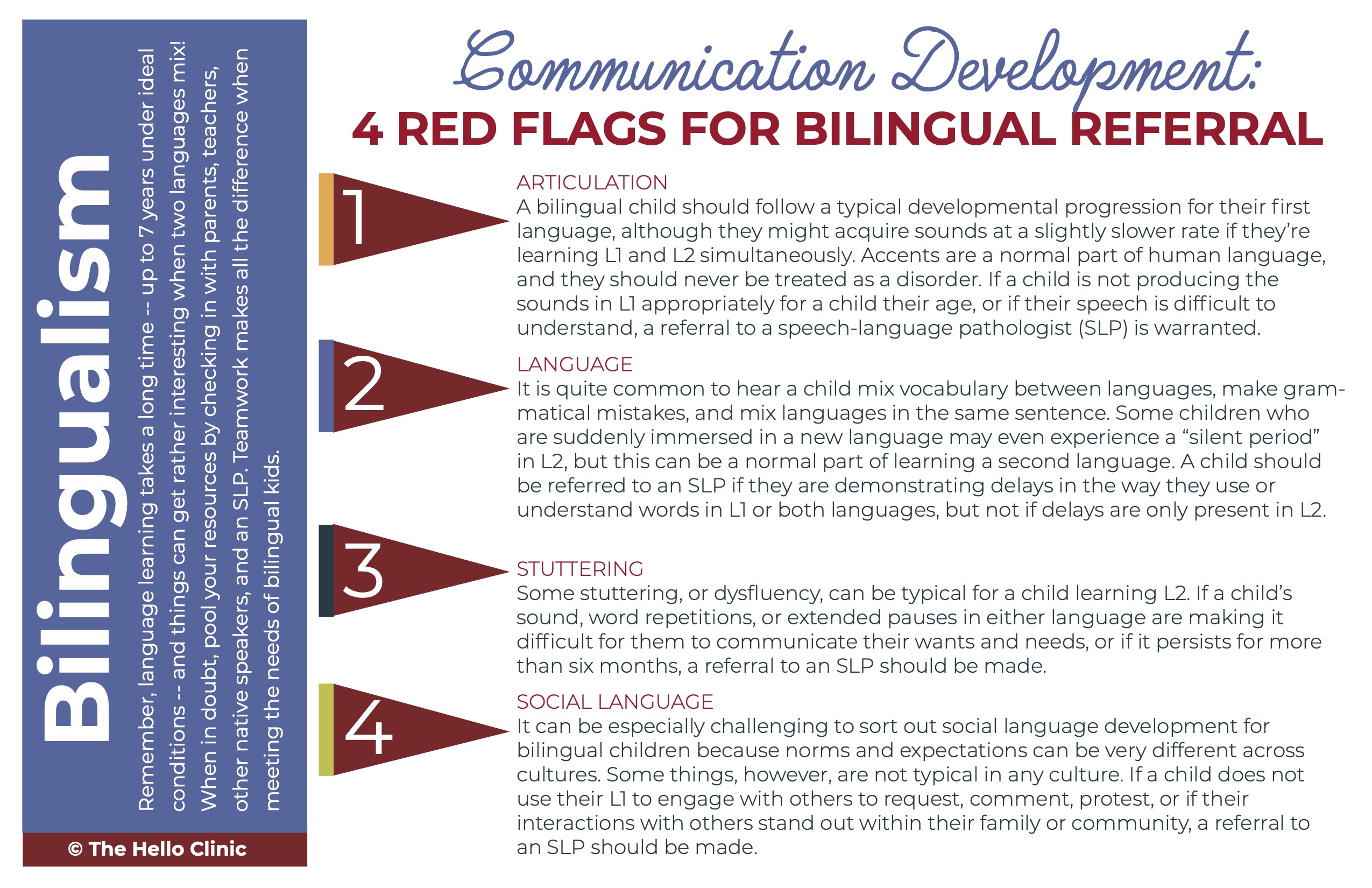
4 Bilingual Communication Development Red Flags
Remember, language learning takes a long time, up to 7 years under ideal conditions, and things can get rather interesting when two languages mix! When in doubt, pool your resources by checking in with parents, teachers, other native speakers, and an SLP. Teamwork makes all the difference when meeting the needs of bilingual kids.
1. Articulation
A bilingual child should follow a typical developmental progression for their first language, although they might acquire sounds at a slightly slower rate if they’re learning language one (L1) and language two (L2) simultaneously. Accents are a normal part of human language, and they should never be treated as a disorder. If a child is not producing the sounds in L1 appropriately for a child their age, or if their speech is difficult to understand, a referral to a speech-language pathologist (SLP) is warranted.
2. Language
It is quite common to hear a child mix vocabulary between languages, make grammatical mistakes, and mix languages in the same sentence. Some children who are suddenly immersed in a new language may even experience a “silent period” in L2, but this can be a normal part of learning a second language. A child should be referred to an SLP if they are demonstrating delays in the way they use or understand words in L1 or both languages, but not if delays are only present in L2.
3. Stuttering
Some stuttering, or dysfluency, can be typical for a child learning L2. If a child’s sound, word repetitions, or extended pauses in either language are making it difficult for them to communicate their wants and needs, or if they persist for more than six months, a referral to an SLP should be made.
4. Social Language
It can be especially challenging to sort out social language development for bilingual children because norms and expectations can be very different across cultures. Some things, however, are not typical in any culture. If a child does not use their L1 to engage with others to request, comment, protest, or if their interactions with others stand out within their family or community, a referral to an SLP should be made.
Schedule Your Child’s Care Assessment Today
At Care Options for Kids, we understand the unique challenges of caring for a child with basic to medically complex health conditions. Our dedicated team of pediatric therapists is here to support your family with compassionate, expert care tailored to your child’s needs. Contact us today to schedule an assessment and learn how we can help you navigate this journey with confidence and care.
Click here to start your journey to better care.
This post is for educational and informational purposes only. You should always speak with your therapist before implementing this information on your own.