
Time for a new installment in our Communication Red Flags series! This time, let’s talk about the early elementary years.
Communication development in early elementary school (kindergarten through 2nd grade) is an exciting time! Starting school means that children learn to understand and manipulate language in a whole new way. Every day brings new things to learn and talk about, and this is also when we see children’s social circles start to take on a life of their own. Here are a few questions to think about if you know kids this age:
- How well are they able to follow complex, new instructions?
- Are they using language to talk about the relationships between people and things?
- Can you understand everything they say and does their speech have few (if any) sound errors?
- Are they able to understand and talk about different people and their perspectives?
- Are they using language to navigate their social world?
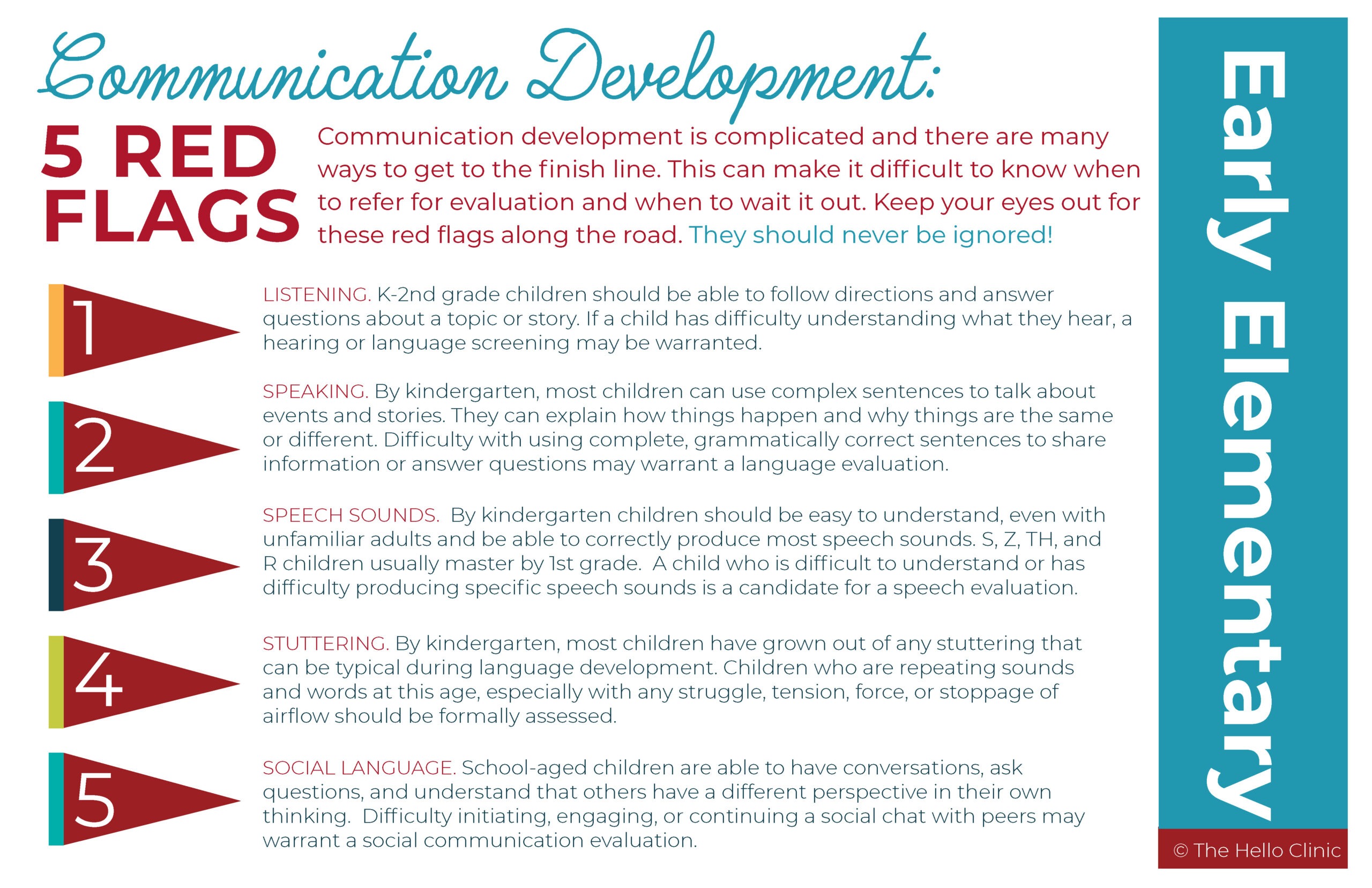
5 Common Communication Developmental Red Flags in Early Elementary Kids
Communication development is complicated and there are many ways to get to the finish line. This can make it difficult to know when to refer for evaluation and when to wait it out. Keep your eyes out for these red flags along the road. They should never be ignored!
1. Listening
Kindergarten through second grade children should be able to follow directions and answer questions about a topic or story. If a child has difficulty understanding what they hear, a hearing or language screening may be warranted.
2. Speaking
By kindergarten, most children can use complex sentences to talk about events and stories. They can explain how things happen and why things are the same or different. Difficulty with using complete, grammatically correct sentences to share information or answer questions may warrant a language evaluation.
3. Speech Sounds
By kindergarten, children should be able to easily understand even unfamiliar adults and correctly produce most speech sounds. S, Z, TH, and R children usually master by first grade. A child who is difficult to understand or has difficulty producing specific speech sounds is a candidate for a speech evaluation.
4. Stuttering
By kindergarten, most children have grown out of any stuttering that can be typical during language development. Children who are repeating sounds and words at this age, especially with any struggle, tension, force, or stoppage of airflow, should be formally assessed.
5. Social Language
School-aged children can have conversations, ask questions, and understand that others have a different perspective in their own thinking. Difficulty initiating, engaging, or continuing a social chat with peers may warrant a social communication evaluation.
Schedule Your Child’s Care Assessment Today
At Care Options for Kids, we understand the unique challenges of caring for a child with basic to medically complex health conditions. Our dedicated team of pediatric home health professionals is here to support your family with compassionate, expert care tailored to your child’s needs. Contact us today to schedule an assessment and learn how we can help you navigate this journey with confidence and care.
Click here to start your journey to better care.