
Do you ever wonder if your young child’s speech-language development is on target? Have questions like these?
- Articulation: How much should you understand at each age?
- Expressive language: Should your child be combining words yet?
- Receptive language: How do you know how much they understand?
- Stuttering: Don’t all kids stutter sometimes?
- Social language: How do you know if there’s a problem?
You’re in luck. We highlighted five communication development red flags for the preschool years.
5 Common Communication Developmental Red Flags in Preschoolers
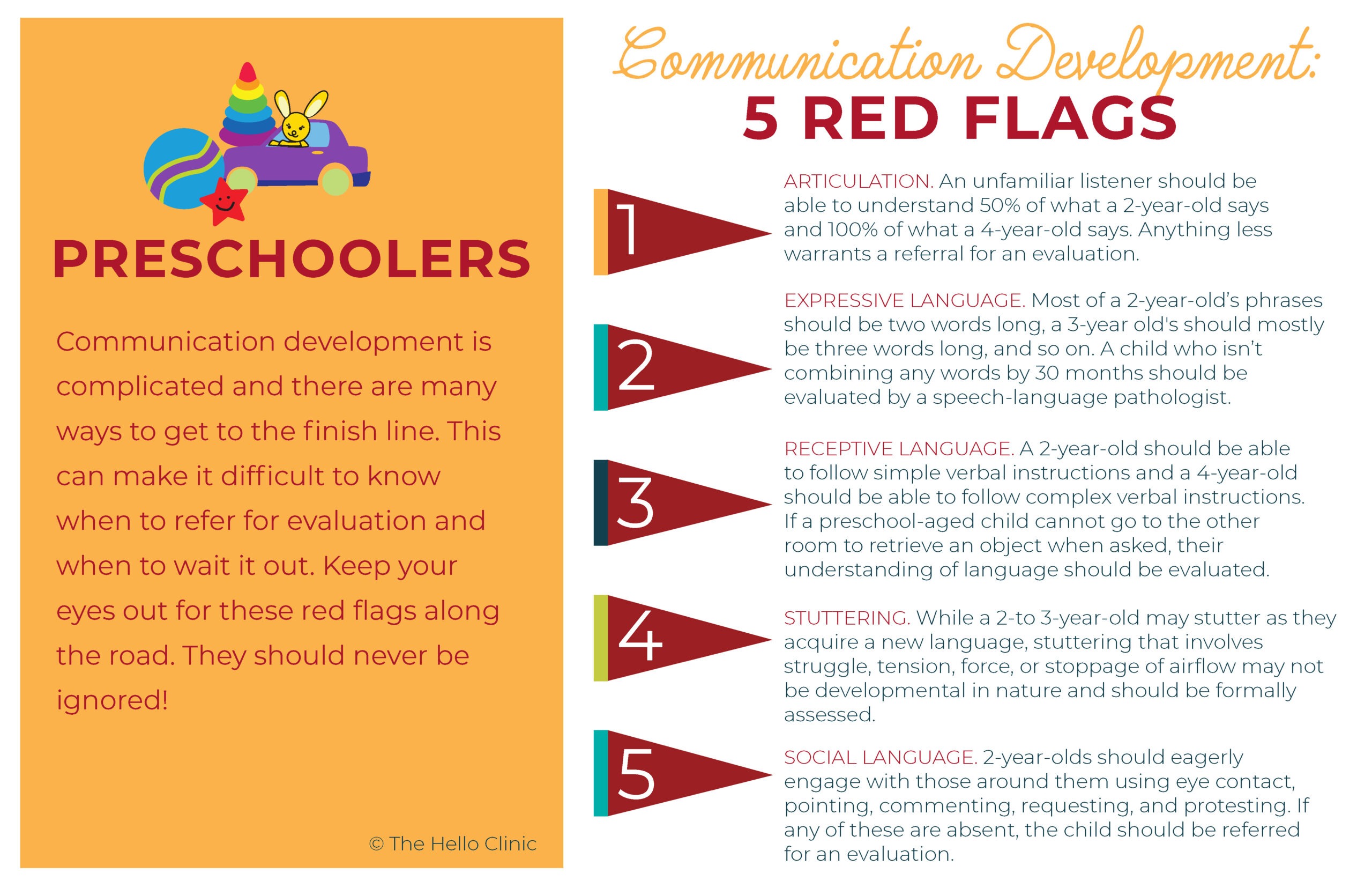
Communication development is complicated, and there are many ways to reach the finish line. This can make it difficult to know when to refer for an evaluation and when to wait it out. Keep your eyes out for these red flags along the road. They should never be ignored!
1. Articulation
An unfamiliar listener should be able to understand 50% of what a 2-year-old says and 100% of what a 4-year-old says. Anything less warrants a referral for an evaluation.
2. Expressive Language
Most of a 2-year-old’s phrases should be two words long, a 3-year-old’s should mostly be three words long, and so on. A child who isn’t combining any words by 30 months should be evaluated by a speech-language pathologist.
3. Receptive Language
A 2-year-old should be able to follow simple verbal instructions and a 4-year-old should be able to follow complex verbal instructions. If a preschool-aged child cannot go to the other room to retrieve an object when asked, their understanding of language should be evaluated.
4. Stuttering
While a 2-to-3-year-old may stutter as they acquire a new language, stuttering that involves struggle, tension, force, or stoppage of airflow may not be developmental in nature and should be formally addressed.
5. Social Language
2-year-olds should eagerly engage with those around them using eye contact, pointing, commenting, requesting, and protesting. If any of these are absent, the child should be referred for an evaluation.
Schedule Your Child’s Care Assessment Today
At Care Options for Kids, we understand the unique challenges of caring for a child with basic to medically complex health conditions. Our dedicated team of pediatric home health professionals is here to support your family with compassionate, expert care tailored to your child’s needs. Contact us today to schedule an assessment and learn how we can help you navigate this journey with confidence and care.
Click here to start your journey to better care.