
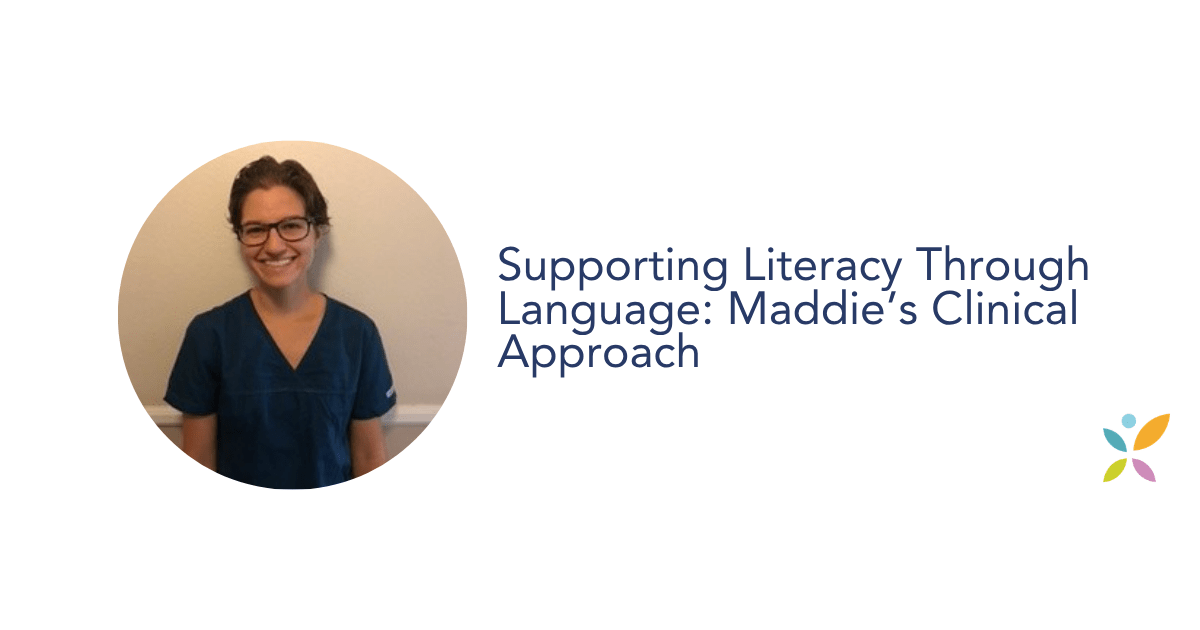
Maddie is a Speech-Language Pathologist originally from Cleveland, Ohio. She earned her bachelor’s degree from the University of Connecticut and went on to complete her master’s degree at West Virginia University. Maddie is deeply passionate about working with the pediatric population and has experience in both school-based and home health settings. This background has given her a strong understanding of how literacy development connects across both home and academic environments.
Maddie specializes in literacy intervention, though she is also experienced in treating a wide range of speech and language disorders. Outside of work, she enjoys traveling, reading, yoga, and pet sitting.
SLP’s Role in Literacy Development
Speech-language pathologists are uniquely positioned to support literacy development because reading and writing are fundamentally language-based skills. The same linguistic foundations that support spoken communication—phonological awareness, vocabulary, syntax, and discourse—are also the building blocks of literacy.
When a child struggles with reading or writing, there is often an underlying language component contributing to those difficulties. SLPs are trained to identify and address these root causes, making them essential members of any literacy intervention team.
Signs of Literacy Delays
Literacy delays can present in a variety of ways depending on the child’s age and developmental stage.
In younger children, early signs may include:
- Difficulty recognizing letters
- Limited phonological awareness, such as challenges with rhyming or syllable segmentation
- Trouble learning letter-sound correspondences
In school-age children, literacy challenges may appear as:
- Slow or effortful reading
- Frequent decoding errors
- Weak reading comprehension
- Difficulty with spelling and written sentence structure
- Inability to read grade-level text with fluency
From an SLP perspective, these challenges are often closely linked to underlying language difficulties. Children who struggle with oral language skills such as vocabulary development or syntax are at a significantly higher risk for reading and writing challenges.
How Literacy Skills Are Assessed
Assessment begins with rapport building, which is essential for obtaining an accurate clinical picture—especially for children who may have experienced frustration or avoidance around reading tasks.
Maddie often uses tools such as Epic Books to identify topics of interest and determine the child’s instructional reading level. This is the level at which a child can read with reasonable accuracy and fluency while still being appropriately challenged. The goal is to identify text that supports growth without overwhelming the learner.
This informal approach is paired with clinical observation of decoding strategies, reading fluency, and comprehension skills to develop a comprehensive understanding of the child’s literacy profile.
Individualized Treatment Planning
Treatment planning is guided by the child’s instructional level and the specific areas of need identified during assessment.
If phonological awareness or decoding is the primary area of difficulty, intervention begins at the sound-symbol level before progressing to connected text. If comprehension is the main challenge, therapy focuses on vocabulary development, inferencing skills, and understanding text structure.
A key priority in Maddie’s approach is building confidence alongside skill development. Early success at the child’s instructional level helps establish motivation and trust before gradually increasing task difficulty.
From the beginning, language goals such as vocabulary and syntax are integrated into literacy activities. Research strongly supports this integrated oral language and literacy approach, particularly in speech-language pathology practice.
An Integrated Approach to Literacy
Skilled reading and writing require more than decoding alone—they depend on a strong underlying language system. Maddie’s approach to literacy intervention reflects this understanding by addressing reading and writing through an integrated language framework.
The goal is not only to help children become stronger readers, but to support them in becoming confident communicators who can access, process, and express information across all modalities.
This work remains one of the most meaningful parts of Maddie’s clinical practice, and she is committed to advocating for the essential role of speech-language pathologists in literacy support for every child who needs it.
Join Our Team
If you’re a Speech-Language Pathologist or Speech-Language Pathology Assistant looking to build a meaningful career supporting children and families, Care Options for Kids offers opportunities to grow while making a difference every day.